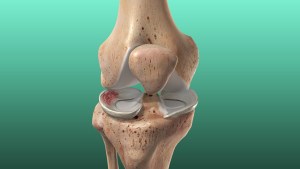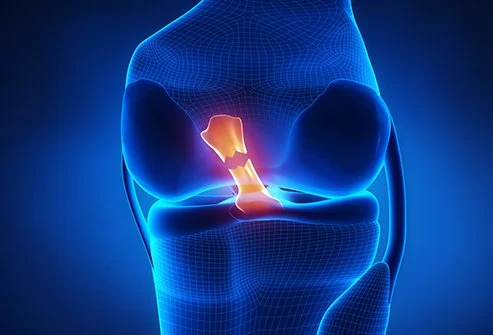
Each knee joint houses four major ligaments. A ligament is an elastic band of tissue that connects bones to each other to provide stability and strength to the joint. The four main ligaments in the knee connect the tibia (shin bone) to the femur (thigh bone). The four ligaments include:
- Anterior cruciate ligament (ACL): This ligament is located in the center of the knee, and controls rotation and forward movement of the tibia (shin bone).
- Posterior cruciate ligament (PCL): The ligament is located in the back of the knee and controls backward movement of the tibia (shin bone).
- Medial collateral ligament (MCL): This ligament gives stability to the inner portion of the knee.
- Lateral collateral ligament (LCL): This ligament gives stability to the outer portion of the knee.
The anterior cruciate ligament (ACL) is one of the most commonly injured ligaments. The ACL is often overstretched and/or torn during sudden twisting motion, especially during sporting activities. The posterior cruciate ligament (PCL) is also a commonly injured ligament that usually tears with sudden, direct impact to the knee. The medial collateral ligament is usually injured more often than the lateral collateral ligament. Stretch and tear injuries to the collateral ligaments are usually caused by a blow to either side of the knee.
The Most Common Signs & Symptoms of Knee Ligament Tears Involving the ACL, PCL, MCL, and LCL
- Knee pain and swelling
- Popping sound in the knee immediately upon injury
- Knee buckling during weight bearing
- Inability to normally walk and move your knee
- Knee instability
(Source: John Hopkins Medicine)
What Are the Treatments for Knee Ligament Tears Involving the ACL, PCL, MCL, and LCL?
Depending on your presentation and the severity of the ligament tear, your health care provider may request an X-ray and/or MRI to further diagnose the tear, while ruling out other possible injuries. Your knee will certainly require safe and effective strengthening and mobilization to optimize function, while weighing surgical options as necessary. Marcel Jacobs PT provides a hands-on physical therapy approach which means you’re going to get fast access to immediate care in order to soothe and relax those tight and aching muscles, mobilize and loosen those restricted and painful joints, and strengthen your body so that you can go back to doing the things that you love. Your therapist will perform a thorough physical examination and evaluation in order to provide you with a deeper understanding of your impairments, compensations, and dysfunctions. You may find yourself having your concerns eased, questions answered, and physical pain reduced inside of 45 minutes with your physical therapist.